
Latest Australian Immigration Updates: What Filipino Migrants Need to Know
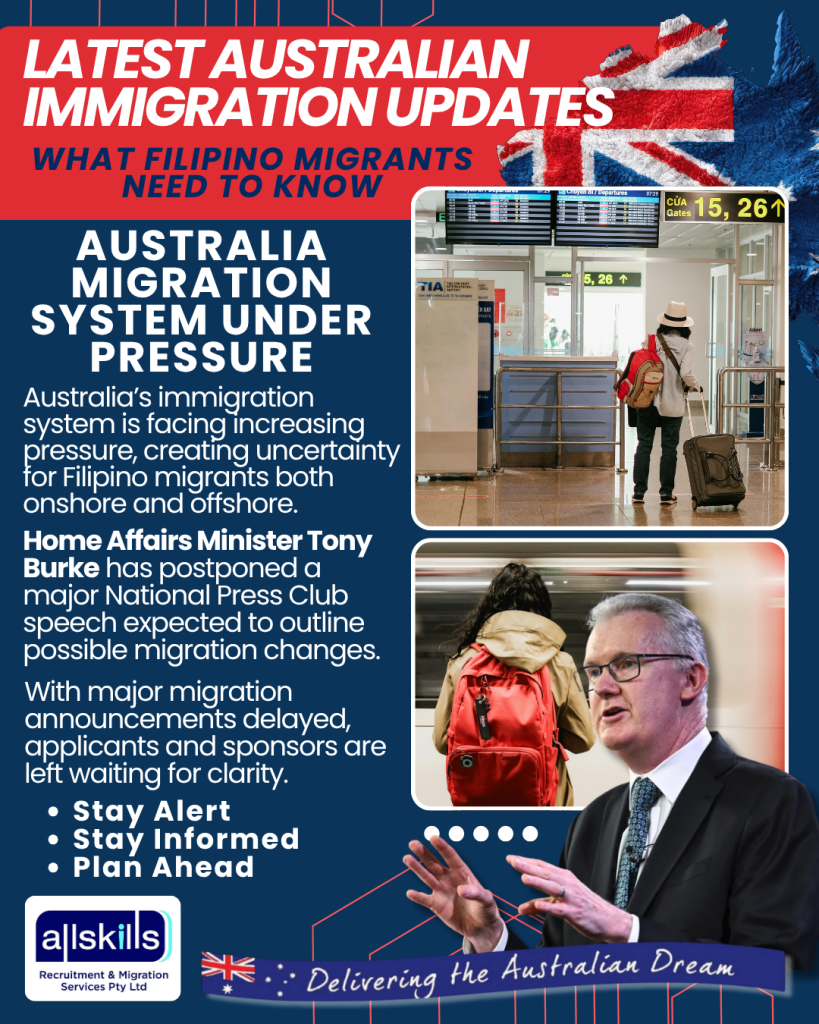
Australia’s immigration system is under pressure, and the latest figures show growing delays that will affect Filipino migrants—both those already in Australia and those still planning to move.
Home Affairs Minister Tony Burke recently postponed a major National Press Club speech expected to announce migration changes. Reports suggested possible cuts to backpacker visas, tighter asylum appeal rights, and stricter family reunion rules. The last-minute cancellation, linked to cabinet disagreements, has left many applicants and sponsors waiting for clarity.
Visa application backlogs (as of end of May 2026):
Employer Nomination Scheme (subclass 186): Nearly 88,000 applications waiting (likely close to 100,000 by the end of the financial year)
Skills in Demand (subclass 482): Almost 57,000 applications pending
Regional Sponsored (subclass 494): Under 4,000 applications
Skilled Independent (subclass 189): Around 15,000 applications
State-Nominated (subclass 190): Around 22,000 applications
Regional Provisional (subclass 491): Nearly 20,000 applications waiting against a much smaller allocation
Family visas face even greater strain. Onshore partner visas (820) had around 75,000–80,000 applications, with offshore partner numbers adding tens of thousands more. Contributing parent visas exceeded 100,000 applicants against only about 7,000 places for the entire parent program. Processing times for many skilled visas are stretching toward two years or more; partner visas risk heading toward three years, and parent visas could approach 20 years.
The Administrative Review Tribunal is also struggling. It is receiving far more cases than it can finalise and is falling further behind. Successful reviews return to the Department with high priority, adding more pressure on already long queues.
What this means for Filipinos
Many Filipinos rely on employer-sponsored pathways (482 then 186), regional visas (491/494), and skilled independent or state-nominated options. Longer processing times mean extended periods on temporary visas and delayed permanent residency. Those already working in Australia may gain some advantage under priority settings that favour onshore applicants in certain occupations, but overall capacity remains tight.
Family reunion is particularly difficult. Partner and parent applications face multi-year waits, making it harder for Australian citizens and permanent residents of Filipino background to bring spouses or ageing parents.
For Filipinos still overseas, competition is high and offshore applicants often face longer delays. Onshore applicants should prepare for extended bridging periods and keep documentation and compliance up to date.
The system is not closed, but it is slower. Filipinos planning a move or already on a pathway should monitor official updates, seek accurate advice early, and build realistic timelines. Patience and strong preparation will matter more than ever.
Felix Carao has been a practising Registered Migration Agent (MARN 1069354) for more than 16 years, a Qualified Education Counsellor (QEAC G028), and an Accredited Recruitment Professional (MRCSA-51889). For enquiries, you may call 0499 599 569 or email him at info@allskills.com.au or visit www.allskills.com.au
Good News for Filipinos Already in Australia: Recent Immigration Changes Favour Onshore Applicants
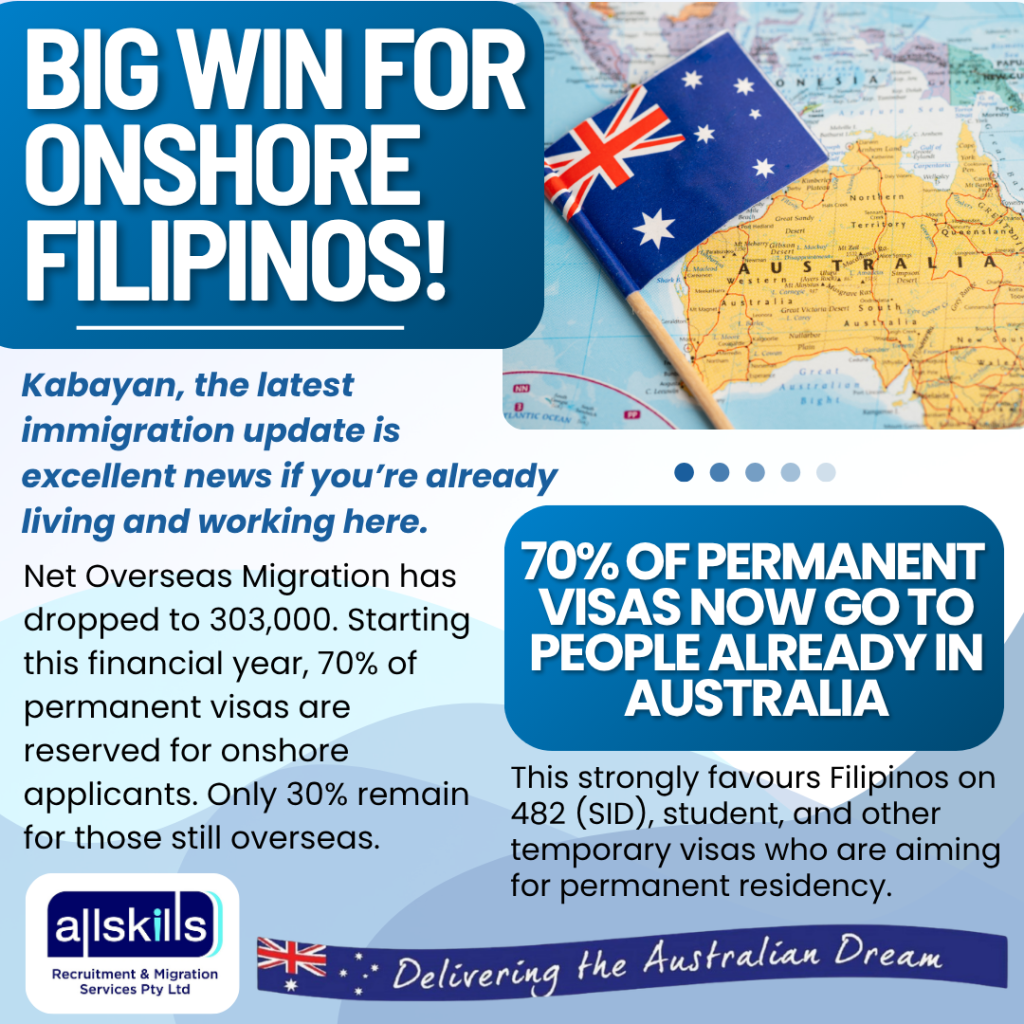
To all my kababayans, recent Australian immigration updates bring encouraging news for Filipinos who are already living and working in Australia. The latest Net Overseas Migration (NOM) figures, released in late June 2026, show a drop to 303,000. This is lower than expected and a big improvement from the post-COVID peak.
Immigration Minister Tony Burke highlighted major policy shifts in the permanent migration program. Starting this financial year, 70% of permanent visas will now go to people already in Australia (onshore), with only 30% available for offshore applicants. This change strongly benefits Filipinos on temporary visas such as subclass 482 (SID), student visas, or other work visas who are aiming for permanent residency.
By giving priority to onshore applicants, the government aims to ease pressure on housing and public services. For Filipinos already contributing through work or study, this means better and faster chances to secure permanent visas like the Subclass 186, 189 or 190 visas. Your time spent in Australia now gives you a real advantage.
The updates also show international student numbers returning to pre-COVID levels and fewer people arriving on temporary visas. While this tightens entry for new arrivals, it opens clearer pathways for those already here.
Note for those still overseas: Offshore partner visas and some skilled visas may now face much longer waits — potentially 4 to 5 years. This mainly affects family members in the Philippines waiting to join sponsors in Australia.
For onshore Filipinos, the situation is far more positive. Employers can sponsor you with less competition from offshore applicants. This is the right time to strengthen your application.
Practical Tips for Filipinos Building Their Future in Australia:
Review your current visa and check eligibility for permanent residency straight away.
Sit an English language test and meet the minimum scores for each component.
Ensure your skills assessment is up to date, especially in priority occupations.
Discuss permanent visa sponsorship options with your employer.
Gather documents and seek professional advice before processing queues become busier.
These recent changes show the government is focusing on migrants who are already settled and working in Australia. For Filipinos on temporary visas who have been working hard to build their lives here, the latest immigration news is timely and encouraging. Acting now can help you move forward on your pathway to permanent residency and a stable future in Australia for you and your loved ones.
Felix Carao has been a practising Registered Migration Agent (MARN 1069354) for more than 16 years, a Qualified Education Counsellor (QEAC G028), and an Accredited Recruitment Professional (MRCSA-51889). For enquiries, you may call 0499 599 569 or email him at info@allskills.com.au or visit www.allskills.com.au
BUILDING YOUR AUSTRALIAN FAMILY DREAM: PARENT VISAS AND REGIONAL PATHWAYS

To all my kababayans, even as Australian immigration policies continue to evolve, exciting opportunities remain for hardworking Filipinos ready to build a brighter future Down Under. Here’s your clear, positive, and practical update on the latest developments that can help you and your family take the next step.
407 Training Visa: Stronger Standards for Genuine Trainees
The Department of Home Affairs has introduced a nationwide inspection program for 407 Training Visas. This is a welcome move that protects sincere applicants and ensures employers provide high-quality, structured training as approved. If you are on a 407 visa, stay focused on mastering the exact skills in your training plan. Many Filipinos have successfully used this pathway to gain valuable Australian experience and advance their careers.
Family Visa Opportunities: More Places for Parent Visas
The 2026–27 Migration Program has allocated 7,060 places for parent visas. This increase provides meaningful hope for Filipino families wanting to reunite with parents and loved ones in Australia. While the process requires careful planning, strong documentation, and a compelling case, many kababayans continue to achieve their dream of living together as a family through these streams. Early preparation and professional guidance greatly improve your chances.
Improved Skills Assessment Process
Trade Recognition Australia (TRA) has rolled out clearer, more user-friendly guidelines for skills assessments, effective June 2026. The new materials use simpler language and step-by-step instructions, making the process easier to understand. Importantly, there are no changes to the actual assessment criteria, eligibility requirements, or outcomes — only better presentation to support applicants and their representatives.
TRA assesses over 100 trade, technical, and related occupations, primarily at Certificate III or IV level. Key sectors include:
• Construction & Building (Bricklayer, Carpenter, Plumber, Electrician, Painter, Tiler)
• Automotive & Mechanical (Motor Mechanic, Diesel Mechanic, Panelbeater, Welder)
• Electrical & Electronics
• Metal Fabrication & Machining
• Hospitality (Chef, Cook, Baker)
• Manufacturing & Specialist Trades (Cabinetmaker, Signwriter, Boat Builder, Aircraft Maintenance)
These occupations remain in strong demand for skilled migration.
Regional Employment Pathways: Flexibility Through DAMA
From July 2026, the Core Skills Income Threshold (CSIT) for the 482 visa will rise to $79,499, which may present challenges for some standard applications. However, there is good news for skilled Filipinos: regional employers in South Australia (Adelaide and regional areas), the Northern Territory (state-wide), and Western Australia (Pilbara, Goldfields, South West, East Kimberley, and other regions) continue to seek reliable, dedicated talent. Designated Area Migration Agreements (DAMA) in these regions offer valuable flexibility, including lower salary thresholds (for example, up to 10% reduced in South Australia and other regional areas and around 15% reduced in the Northern Territory or market salary whichever is higher), more lenient English language requirements, higher age limits (up to 55), and recognition of relevant work experience. Construction, hospitality, mechanics, and other in-demand trades particularly value the work ethic and skills of Filipino tradies and professionals.
Support for Students: Practical Pathways
The Genuine Student (GS) requirement (which replaced GTE in March 2024) asks you to clearly demonstrate through structured responses (up to 150 words each) that studying in Australia is your primary purpose. You must address your circumstances, course relevance, background, and future plans.
Key requirements include:
• Financial proof of at least AUD $29,710 for living costs (one year for the primary applicant), plus tuition and travel.
• Visa fee: AUD $2,000.
• English: Minimum IELTS 6.0 overall (or equivalent), varying by course.
• Work rights: Up to 48 hours per fortnight during term time depending on the course, unlimited during scheduled breaks (unlimited for Masters by Research/PhD).
For Filipinos, TAFE continues to be one of the most affordable and reliable pathways. As the country’s largest public vocational training provider, it offers hands-on Certificates and Diplomas across trades, hospitality, community services, and many other fields — strong foundations for TRA skills assessments, DAMA sponsorship, or 482/494 visas. Through its vocational education and training system, TAFE equips students with practical, job-ready skills that help fill critical workforce shortages across the Australian economy.
Your Australian Dream Is Still Within Reach
Australia remains open to skilled, dedicated individuals and families like yours. The keys to success are solid English skills, relevant work experience, thorough and accurate documentation, and expert guidance. Stay focused, prepare carefully, and move forward with confidence. With determination and the right support behind you, building your family’s future in Australia is absolutely achievable.
Felix Carao has been a practicing Registered Migration Agent (MARN 1069354) for more than 15 years, a Qualified Education Counselor (QEAC G028), and an Accredited Recruitment Professional (MRCSA-51889). For enquiries, you may call 0499 599 569 or email him at info@allskills.com.au or visit www.allskills.com.au
AUSTRALIAN IMMIGRATION UPDATES: SIMPLE GUIDE FOR FILIPINOS (ONSHORE & OFFSHORE)
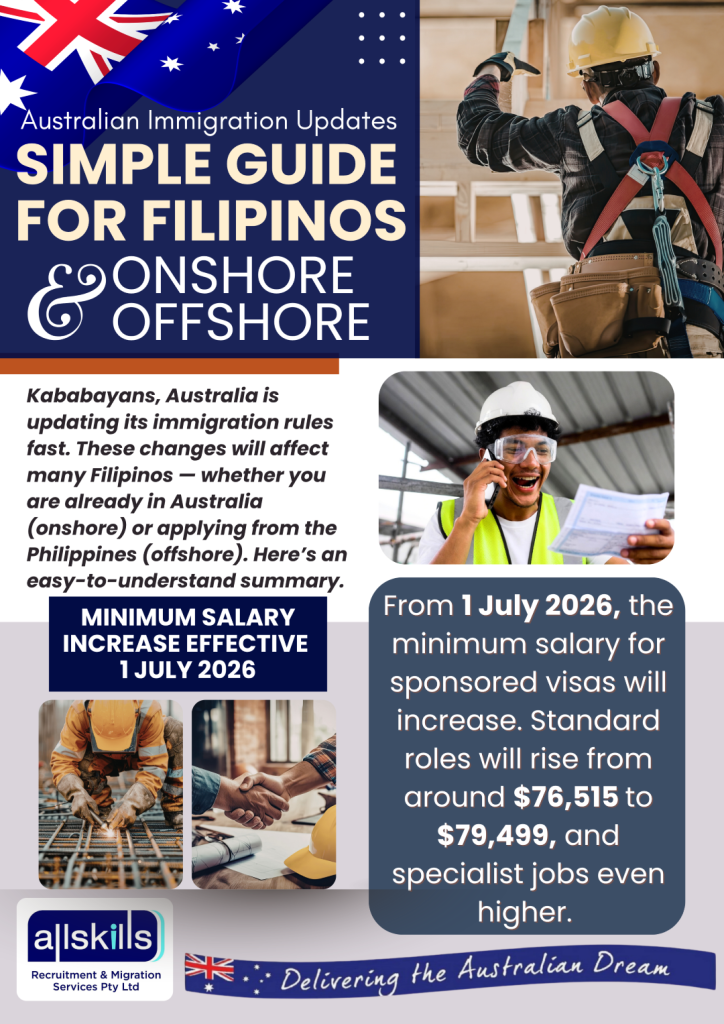
To all my kababayans, Australia is updating its immigration rules fast. These changes will affect many Filipinos — whether you are already in Australia (onshore) or applying from the Philippines (offshore). Here’s an easy-to-understand summary.
Minimum Salary increase effective 1 July 2026
From 1 July 2026, the minimum salary for sponsored visas will increase. Standard roles will rise from around $76,515 to $79,499, and specialist jobs even higher. If you are onshore and negotiating with your employer, do it quickly before the deadline.
Subclass 309/820 Partner Visas: Many Filipino-Australian couples are receiving phone calls from the Department of Home Affairs asking for more documents. Reply promptly. Beware of scams — the real department will never ask for bank details or money over the phone. Some second-stage visas are being refused if couples miss document requests, even if they are living together.
Subclass 500 – Student Visas: Refusal rates are high, especially for applicants from certain countries.
Subclass 485 -Temporary Graduate Visa fee has doubled to $4,600. Plan carefully if you are studying in Australia.
Good News for Parents: Starting 22 April 2026, many Parent Visas can now be lodged online through ImmiAccount. This is much easier than the old paper system. It will help both offshore parents and those waiting in the Philippines. However, processing times can vary.
Visa Refusals & Appeals: If your visa is refused, appeals may be decided on documents only, without an interview. Strong written evidence is very important.
State Nominations: Spots for skilled migration are almost full. Some states have already closed before 30 June 2026. Check your occupation list quickly.
Important Advice
• Always use a MARA-registered migration agent.
• Prepare complete documents and reply quickly to any requests.
• Onshore applicants: Don’t delay transitioning from temporary to permanent visas.
• Offshore applicants: Be extra careful with financial proof and genuine temporary entrant requirements.
Australia still needs many workers in healthcare, aged care, construction, and hospitality — areas where Filipinos often succeed. Stay updated and act early.
Felix Carao has been a practicing Registered Migration Agent (MARN 1069354) for more than 15 years, a Qualified Education Counselor (QEAC G028), and an Accredited Recruitment Professional (MRCSA-51889). For enquiries, you may call 0499 599 569 or email him at info@allskills.com.au or visit www.allskills.com.au
ONE EMPLOYER, ONE FUTURE: HOW THE 482 VISA LEADS TO AUSTRALIAN PR
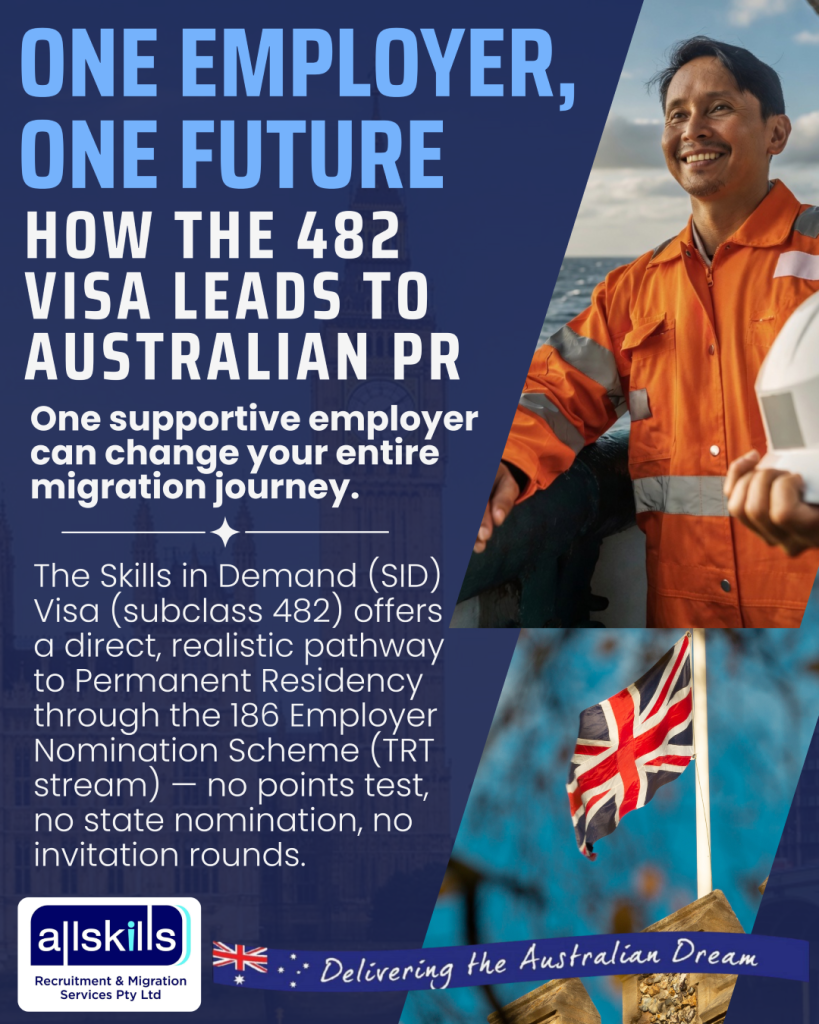
To all my kababayans, one supportive employer can completely change your migration journey in Australia. The Skills in Demand (SID) visa (subclass 482) provides a clear pathway to permanent residency (PR) through the Employer Nomination Scheme (ENS) subclass 186 Temporary Residence Transition (TRT) stream — without points tests, state nominations, or waiting for invitation rounds.
Many skilled migrants spend years frustrated with the points-based system — completing skills assessments, English tests, and Expressions of Interest, only to face repeated rejections. For many, everything changes when they finally gather the courage to speak with their employer about sponsorship. In countless cases, one honest conversation transforms their uncertain future into a clear and straightforward pathway to permanent residency.
What is the 482 Visa?
The 482 visa (commonly called the Skills in Demand visa) lets approved Australian employers sponsor skilled workers when they cannot find suitable local talent. It offers:
Full-time work in Australia for up to 4 years
The ability to bring your spouse and dependent children
A salary above the Core Skills Income Threshold (currently $76,515, rising to $79,499 from 1 July 2026)
Your occupation must appear on the Core Skills Occupation List (CSOL), which includes 456 occupations. Most occupations do not require a skills assessment. You need at least one year of relevant work experience (full-time or equivalent) in the nominated occupation or a closely related field, plus English proficiency of IELTS 5.0 overall (with 5.0 in each band) or equivalent. The critical step is securing a nomination from an approved employer sponsor.
Finding a sponsor can be challenging, but many businesses are willing when your skills address a genuine shortage. Be proactive, prove your value, and build strong workplace relationships.
The 482 to 186 TRT Pathway
After working full-time for your sponsoring employer(s) in the same occupation for at least two years on a 482 visa, you may become eligible for permanent residency through the 186 Temporary Residence Transition (TRT) stream. This pathway is often the most practical option for applicants who are unsuccessful with points-tested visas.
Key 186 TRT requirements:
At least 2 years of qualifying employment with your nominating employer
Competent English: IELTS 6.0 overall (or equivalent)
Generally under 45 years of age (exemptions available for high-income earners above the Fair Work High Income Threshold, certain lecturers/academics, medical practitioners in regional areas, and other specified roles)
No skills assessment needed at the PR stage
Continued employer nomination
Meet health, character, and salary standards
The pathway is not automatic — your employer must nominate you again for the permanent visa. Recent changes provide some flexibility to change employers (with 180 days to find a new sponsor), but you generally still need two full years with an approved nomination with one or more sponsors.
Applicants over 45 should explore exemptions or regional options like Designated Area Migration Agreements (DAMA).
Why This Pathway Matters
The 482–186 route focuses on real employer needs rather than competition. It delivers stability, family unity, and a predictable timeline toward PR and eventual citizenship.
Next steps:
Check if your occupation is on the CSOL.
Improve your English and organise work evidence.
Network with Australian employers and highlight how you solve their skill gaps.
Once on a 482 visa, perform strongly and discuss long-term sponsorship early.
This pathway has helped thousands of migrants build a life in Australia. Always verify the latest rules on the Department of Home Affairs website (immi.homeaffairs.gov.au), as policies can change. Consider consulting a registered migration agent (MARA-registered) for personalised advice.
Your Australian PR journey could begin with one courageous conversation. Take that step confidently — your future starts now.
Felix Carao has been a practicing Registered Migration Agent (MARN 1069354) for 16 years, a Qualified Education Counselor (QEAC G028), and an Accredited Recruitment Professional (MRCSA-51889). For enquiries, you may call 0499 599 569 or email him at info@allskills.com.au or visit www.allskills.com.au
SUBCLASS 407 TRAINING VISA: UPDATED 2026 PATHWAY FOR GENUINE SKILLS TRAINING IN AUSTRALIA
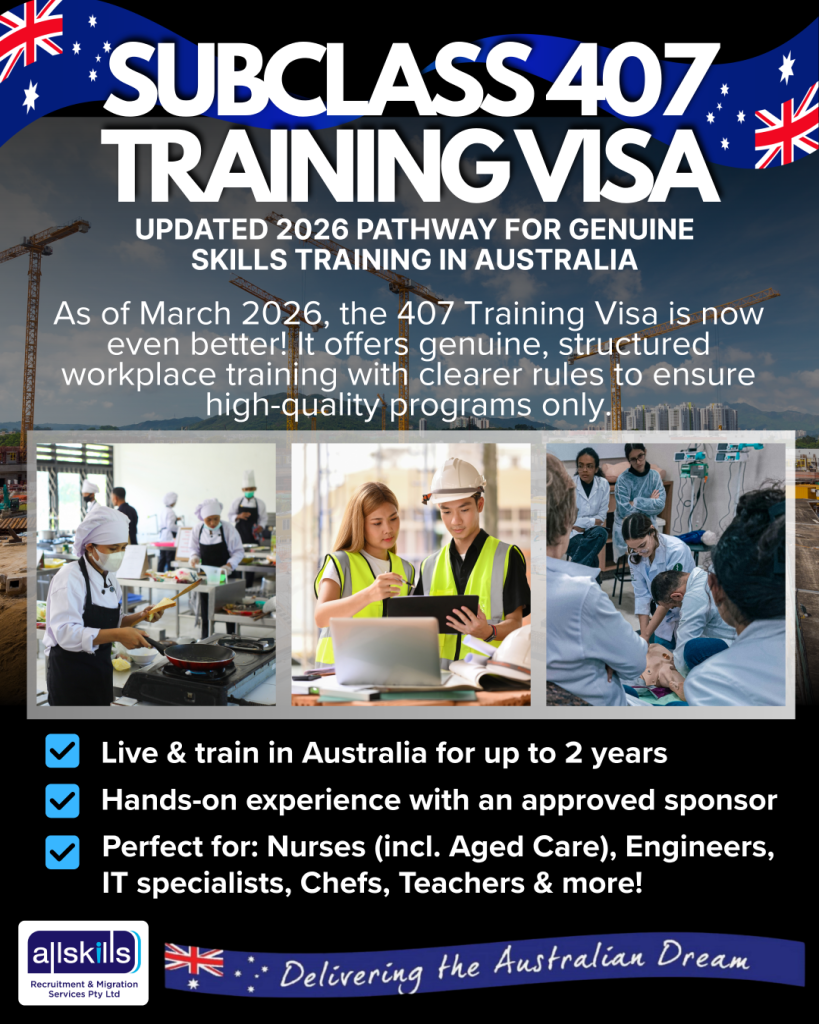
To all my kababayans, good news! As of 2026, the Subclass 407 Training Visa offers Filipinos a wonderful chance to develop real skills through structured workplace training in Australia. With the updates effective 11 March 2026, the process is now clearer and ensures only genuine training programs are approved — giving you a high-quality learning experience.
This visa allows you to live and train in Australia for up to 2 years with an approved sponsor. It focuses on hands-on skill development in a supportive environment, making it an excellent stepping stone for your career.
It is especially suitable for nurses (including aged care), engineers, IT specialists, chefs, and teachers. Every day you work will be part of a well-planned training program designed to help you grow professionally.
How the 407 Visa Works (Updated 2026 Process)
The process is now nicely streamlined:
Sponsorship — Your Australian employer becomes an approved sponsor.
Nomination — The sponsor prepares and gets approval for a clear, structured training plan tailored for you.
Visa Application — You apply for the visa only after the sponsorship and nomination are approved.
This step-by-step approach helps ensure your training is meaningful and valuable.
The Three Main Streams
Registration or Licensing — Perfect for nurses, doctors, and allied health professionals who want to meet Australian standards.
Skills Improvement — The most popular stream. Ideal if your occupation is on the skilled list and you have relevant experience.
Capacity Building — Great for shorter programs (up to 6 months) to bring new skills back to the Philippines.
Key Benefits & Requirements
Stay up to 2 years with focused, practical training
Build valuable Australian workplace experience
Functional English level required (IELTS 4.5 or equivalent)
Meet standard health and character requirements
Work as part of your approved training program
Comparison with Subclass 482 Visa
The 407 is excellent for gaining quality training and experience. Once you’ve built your skills, many Filipinos happily move to the 482 Skills in Demand visa, which offers longer stays (up to 4 years), better pay, and a clearer pathway to permanent residency. The 407 often serves as a strong and positive first step toward that goal.
Why It Matters for Filipinos
Filipinos are highly valued in Australia, especially in healthcare, where our “alaga” spirit and caring nature shine. The 407 visa is a fantastic opportunity to gain Australian experience, support your family through remittances, meet registration needs, and build a brighter future Down Under.
Final Encouragement
Choose a reliable sponsor with a genuine training plan and consult a MARA-registered migration agent for friendly guidance. Check the latest details on the official website: immi.homeaffairs.gov.au
The Subclass 407 Training Visa can be your exciting first step toward professional growth and a rewarding life in Australia. With careful planning and the right support, many Filipinos are successfully turning this opportunity into long-term success. You can too!
Felix Carao has been a practicing Registered Migration Agent (MARN 1069354) for 16 years, a Qualified Education Counselor (QEAC G028), and an Accredited Recruitment Professional (MRCSA-51889). For enquiries, you may call 0499 599 569 or email him at info@allskills.com.au or visit www.allskills.com.au
BEAT THE JULY DEADLINE – LOCK IN LOWER SALARIES FOR 482, 494, AND 186 VISAS

If your business is thinking about sponsoring skilled workers from overseas on a 482, 494, or 186 visa, you need to know about an important change coming soon. Starting 1 July 2026, the minimum salary you must pay these workers (known as the Core Skills Income Threshold, or CSIT) will increase from $76,515 to $79,499 per year. That’s an extra $2,984 a year. This new higher-salary rule will apply to any sponsorship applications submitted on or after 1 July 2026. If you lodge your application before 1 July 2026, it will still be assessed under the current lower salary amount of $76,515.
Why Does the Minimum Salary Go Up Each Year? Every year, the Australian Government increases the income threshold for skilled visas. The minimum salary is calculated automatically using official wage statistics from the Australian Bureau of Statistics (ABS). This year, the increase is about 3.9%, which is lower than last year’s 4.6% rise. The reason is simple: wages across Australia have not been growing as fast this year as they did last year.
Why Employers Should Lodge Before 1 July 2026
Because the minimum salary is going up, sponsoring a new worker will become more expensive after 1 July. If your business is planning to bring in skilled overseas workers on a 482 visa (temporary), 494 (regional provisional), or move them to permanent residency through the 186 visa, it’s smart to act now. Submitting your application before the deadline can help you avoid the higher salary requirement and save money. This is especially important if you are currently recruiting or preparing offers for overseas talent. Allskills Recruitment and Migration Services will be glad to assist if you have any questions about the process. Whether you need help with eligibility, preparing the paperwork, or timing your application correctly, our team is ready to support you. Don’t wait until it’s too late. Contact Allskills Recruitment and Migration Services today to discuss your sponsorship plans and make sure everything is lodged before 1 July 2026. Your business needs the right people — let’s make sure you secure them under the current rules while you still can.
AUSTRALIA’S 2026 IMMIGRATION BOOM: GREAT NEWS FOR SKILLED FILIPINOS
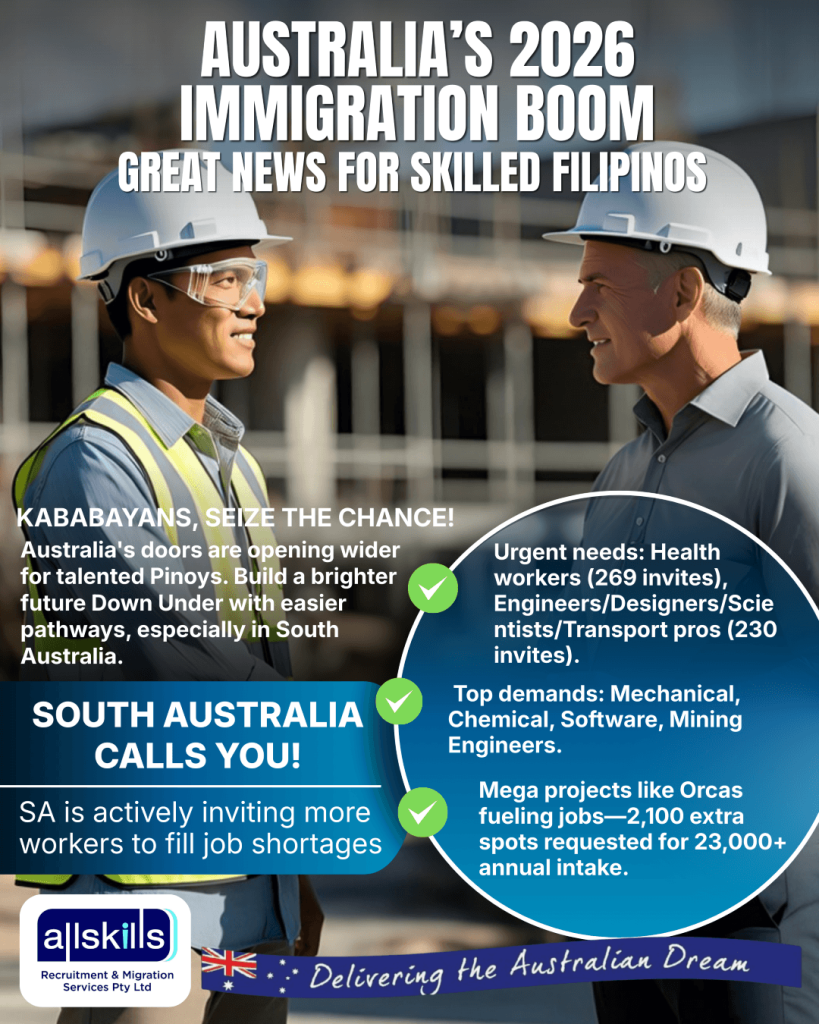
To all my kababayans, Australia’s skilled migration system is opening up exciting new chances in 2026. The country needs more talented workers, and recent changes are making it easier for skilled people — especially from the Philippines — to build a better future Down Under.
South Australia Wants More Skilled Migrants
South Australia is actively inviting more workers to fill job shortages. In the latest rounds, they issued 269 invitations to health workers and 230 to engineers, designers, scientists and transport professionals. They especially need mechanical, chemical, software and mining engineers.
Big projects like Orcas are creating even more demand. The state has asked for 2,100 extra places to keep its yearly intake over 23,000.
This is very good news for Filipino aspirants. The Philippines is already one of Australia’s top sources of skilled migrants. Many Filipino nurses, engineers, IT workers and aged-care staff are thriving there. Filipinos are known for strong English skills, recognised qualifications, and a hardworking, friendly attitude. South Australia’s urgent need for exactly these jobs gives Filipino families a clear and realistic path to state nomination, faster permanent residency, and a stable new life in Australia.
Fairer Points Test Coming Soon
The federal government is updating the points test to make it simpler and fairer. The old system is outdated, so new rules will better reward in-demand skills in construction, defence and other key areas. Changes are expected by mid-2027 — great timing for serious applicants.
NSW 190/491 Tip
New South Wales still offers the popular 190 and 491 visas, but they now carefully check that your work experience matches your job. Make sure your qualifications clearly relate to the occupation. With good preparation, most applications go smoothly.
Key Takeaway
2026 is full of real opportunities for skilled Filipinos. South Australia is welcoming you, the points system is improving, and preparation is the key to success. Stay updated, get professional advice, and take the next step — Australia’s doors are opening wider than ever.
Felix Carao has been a practicing Registered Migration Agent (MARN 1069354) for 16 years, a Qualified Education Counselor (QEAC G028), and an Accredited Recruitment Professional (MRCSA-51889). For enquiries, you may call 0499 599 569 or email him at info@allskills.com.au or visit www.allskills.com.au
POSITIVE PATHWAYS FOR FILIPINO PARTNER VISAS IN AUSTRALIA 2026

Australia’s immigration system in 2026 offers promising opportunities for Filipino families seeking to reunite through partner visas. Despite growing demand, the process remains open and demand-driven under the Migration Act, ensuring that genuine applications can succeed with proper planning. This update highlights the resilience of the system, ways to navigate processing times, and tips for onshore and offshore Filipinos aiming for a brighter future together Down Under.
Embracing the Demand-Driven System
Partner visas are designed to support loving relationships without strict caps, as mandated by Section 87 of the Migration Act. While applications have risen to 96,839—reflecting Australia’s appeal as a welcoming destination— this shows the program’s vitality. Processing times, now averaging 2-3 years, provide applicants with ample opportunity to strengthen their cases, gather documents, and build a solid foundation for life in Australia.
For Filipinos, this is a chance to turn waiting into preparation. Offshore applicants from the Philippines can use the time to enhance English skills or pursue education, boosting future integration. Onshore Filipinos already in Australia benefit from stability during the wait, often extending temporary visas to stay with partners. With fees around AUD 10,000, it’s an investment in a shared future, and many find the eventual approval rewarding.
Navigating Changes with Confidence
Recent policy clarifications for skilled visas that include partners emphasize transparency and fairness. Points for partners are now assessed at the case officer stage, encouraging upfront declarations. This helps genuine couples avoid surprises and streamlines approvals. Migration experts note that while adjustments may seem strict, they protect the integrity of the system, leading to more reliable outcomes.
Filipino couples can thrive by acting early: declare partners at the invitation stage and seek professional advice. Offshore Filipinos might explore bridging visas for visits, while onshore ones can leverage community support networks in cities like Sydney or Melbourne.
State Support and Broader Opportunities
States like South Australia and Tasmania are actively inviting skilled migrants, which can indirectly benefit partner visa holders through regional pathways. In January 2026, hundreds of invitations were issued, opening doors to permanent residency and family stability.
Key Tips for Success
Focus on positivity: Australia’s commitment to family unity shines through. Apply promptly, stay informed via official channels, and consult registered agents. For onshore Filipinos, engage in local Filipino communities for encouragement; offshore, virtual resources keep hope alive. With patience and preparation, many families reunite successfully, embracing Australia’s vibrant lifestyle.
This evolving landscape underscores Australia’s dedication to inclusive migration— a positive step for Filipino dreams.
Felix Carao has been a practicing Registered Migration Agent (MARN 1069354) for 14 years, a Qualified Education Counselor (QEAC G028), and an Accredited Recruitment Professional (MRCSA-51889). For enquiries, you may call 0499 599 569 or email him at felix@allskills.com.au or visit www.allskills.com
AUSTRALIA’S 2026 VISA FORECAST: WHAT MIGRANTS MUST PREPARE FOR
Australia’s immigration landscape is undergoing significant changes, as revealed in the December 2025 updates. With substantial cuts to skilled migration visas and evolving government priorities, prospective migrants need to adapt their strategies for 2026. This article explores key trends, reductions in visa allocations, practical pathways to permanent residency (PR), and future predictions.
189 Visa Invitation Trends
The November 2025 invitation round for the Skilled Independent (189) visa prioritized sectors like construction, health, teaching, economists, and multimedia specialists. Quarterly rounds suggest the next invitations could occur in February or March 2026. Applicants in these competitive fields should monitor updates closely to capitalize on opportunities.
Reductions in 190 and 491 Visa Allocations
Nationally, allocations for Skilled Nominated (190) and Skilled Work Regional (491) visas have been slashed by 23%. South Australia (SA) faces the steepest cut at 41%, while New South Wales (NSW), Victoria, and Tasmania also see declines. In contrast, Queensland’s allocation surged by 117%. These reductions intensify competition and limit available occupations, forcing migrants to refine their expressions of interest (EOIs).
Four Pathways to Boost PR Prospects
To navigate these challenges, consider these strategies:
Persist with 190/491 Visas: Highly skilled workers in construction, health, or teaching may still succeed by submitting strong EOIs.
Relocate Interstate: Move to states with stronger allocations, such as Western Australia (WA) or the Northern Territory (NT), if your occupation aligns.
Explore Alternative Visas: Opt for employer-sponsored options like the Temporary Skill Shortage (482) or Employer Nomination Scheme (186) visas, which lack allocation caps. Partner and training visas also remain viable.
Retrain for High-Demand Trades: New graduates with remaining visa time can upskill in priority areas to enhance eligibility.
South Australia Nomination Updates
SA’s total places are now limited to 2,250, focusing on construction, engineering, education, and health. Many occupations have shifted exclusively to the 491 visa, and the graduate pathway has been eliminated for several roles, narrowing options for recent students.
National Innovation Visa Progress
This emerging pathway targets global talent but is highly selective. For instance, NSW invited only five applicants from over 1,250 EOIs, underscoring the need for exceptional qualifications.
Insights on Appeals and Partner Visas
Visa appeals require careful preparation amid a busy partner visa season. Early predictions for 2026 indicate stricter state selections, increased reliance on employer-sponsored visas, prolonged 186 processing times, and expanded labour agreements.
Australia’s 2026 migration environment will be fiercely competitive, but informed planning and flexibility can improve outcomes. Migrants should reassess their paths, explore alternatives, stay updated via official sources, and consult a registered migration agent for personalized advice and a smooth transition.
Felix Carao has been a practicing Registered Migration Agent (MARN 1069354) for 14 years, a Qualified Education Counselor (QEAC G028), and an Accredited Recruitment Professional (MRCSA-51889). For enquiries, you may call 0499 599 569 or email him at felix@allskills.com.au or visit www.allskills.com