
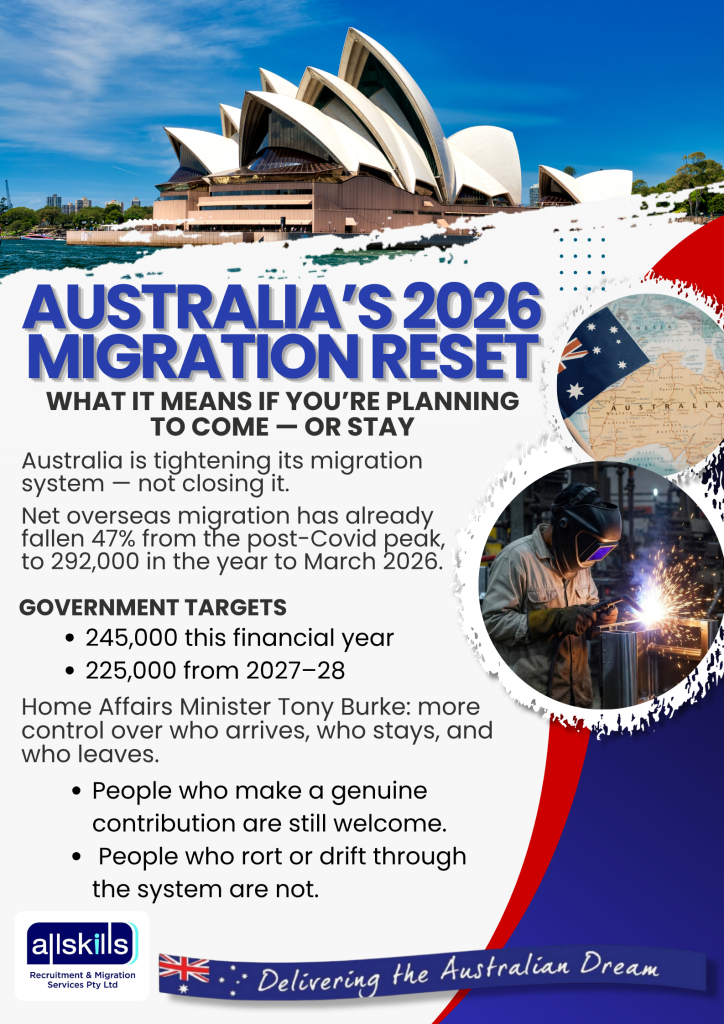
Australia is tightening its migration system, not closing it. Net overseas migration has already fallen 47 per cent from its post-Covid peak, to 292,000 in the year to March 2026. The government’s targets are 245,000 this financial year and 225,000 from 2027–28.
Home Affairs Minister Tony Burke summed up the aim as more control over who arrives, who stays and who leaves. People who make a genuine contribution are still welcome. People who rort or drift through the system are not.
These changes apply across nationalities. Some groups will feel them more than others, depending on the visa they use. Most measures are being made through regulation and ministerial direction, so exact start dates are still to be confirmed.
Skilled workers in shortage jobs get priority — not a free pass.
Applications linked to healthcare, construction, education, law enforcement and defence stay at the front of the queue, and resources, agriculture, aquaculture and fishing have been added. A redesigned points test is expected to give trade qualifications in housing and construction the same weight as a university degree. That helps nurses, teachers, builders, tradespeople and regional workers on visas such as the Skills in Demand (482), 186 and 491. Priority changes how fast a complete file is looked at. It does not change English, skills-assessment or nomination requirements.
Student visas will be harder to use as a long-term family stay.
Most new student and graduate (485) visas will not allow a partner or children as secondary applicants. Exceptions are expected for PhD students and for students from Pacific and ASEAN countries. Everyone else should assume family cannot come until the final rules are published. The government is also targeting “visa hopping”: staying for years by stacking similar lower-level courses. Future extensions will require a genuine step up, such as bachelor to masters. People already here on current student and secondary visas are not being told those visas will be cancelled.
New visitor visas will block onshore switching.
A “no further stay” condition will be attached to all new visitor visas. That closes a common path: arrive as a tourist, then lodge an onshore partner, student or work visa. Existing visitor visas keep the conditions they were granted with.
Working holiday visas get a ballot and fewer extra years.
First-year working holiday visas continue, but years two and three will go to a ballot, with regional work still required (UK passport holders remain exempt from the regional work requirement). Places fall sharply — 45,000 for year two, down from 57,000, and 5,000 for year three, down from 31,000. Eligible applicants are promised faster processing.
Compliance, agents and character.
People without a valid visa are expected to leave, backed by around 100 extra compliance officers and 250 more detention beds. Agents who knowingly lodge applications without merit face a crackdown. Character settings will put more weight on protecting children and family-violence victims, and on rejecting hatred and serious crime.
The practical takeaway, whatever your passport.
If you have skills Australia has listed as a priority, or a genuine family or study pathway, the system is still open — but it now expects the visa to match the purpose from day one. If you planned to enter as a visitor or student and work out a longer stay later, that route is closing.
The right pathway today may not be the one that worked last year. Before you lodge, pay fees or book travel, contact a registered migration agent or lawyer for a review of your situation. They will help you find the visa that matches your purpose and keep your plans on track under the new policies.
Felix Carao has been a practising Registered Migration Agent (MARN 1069354) for more than 16 years, a Qualified Education Agent Counsellor (QEAC G028), and an Accredited Recruitment Professional (MRCSA-51889). For enquiries, call 0499 599 569, email info@allskills.com.au or visit www.allskills.com.au.
